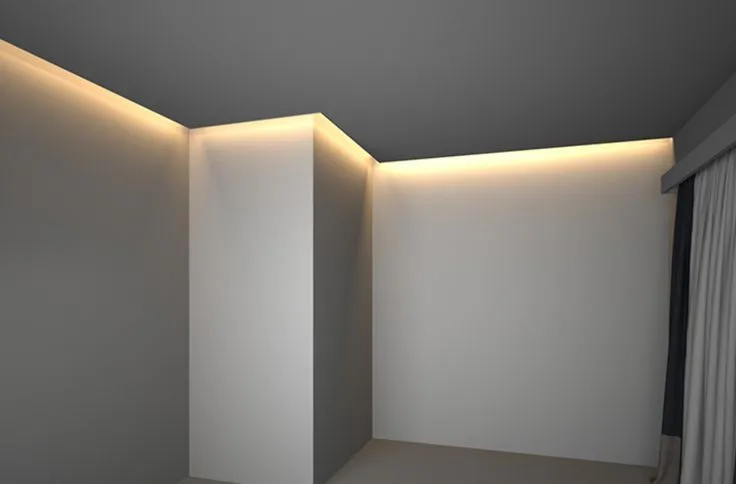
It is common nowadays for interior spaces to incorporate lighting as an integral part of the design rather than as an independent element. Recessed LED systems provide a visual discrete light source that can be used to create a clean line across ceilings, walls, cabinetry, and more. The right channel selection is crucial, as it will impact the installation, look, protection and overall styling of the finished lighting project in relation to the surrounding materials.
Start With the Installation Method
The first one should depend on the location of the lighting fixtures. Different channel designs may be needed for ceiling details, drywall surfaces, cabinetry, walls and custom architectural details.
A recessed aluminum LED channel is one that is installed inside a cutout that is cut into a surface instead of being applied to the surface. This results in a more unified look and could also help to prevent the LED strip from being damaged while inside the profile.
Verify the channel sizes before choosing a channel. There should be a sufficient amount of space for the profile, LED strip, wiring and mounting parts. These measurements can be avoided by planning them early to avoid problems during finishing work.
Consider the Finished Appearance
The LED strip makes up less than the total picture. The width, depth, style of diffuser and location of the installation can all affect the look of the light.
The profile width can be used to accommodate larger LED strips and better light distribution with a wider profile, or can be used for a more subtle decorative line with a narrow profile. The diffuser will also help to diffuse the light and give a more even look to the light.
Consider what the channel will look like with the lights turned off as well. In high-quality interior applications, the profile should fuse seamlessly with the ceiling, wall, cabinetry or architectural surface that it is integrated into.
Understand Trimless Installation
When installed properly, some modern designs can achieve a seamless surface that has almost no discernible edges around the light’s perimeter, and this design can be accommodated by trimless LED channel systems.
These systems are ideal for drywall ceilings and walls where the channel will be a part of the final surface. It is important to prepare the ground in a proper manner, as the surrounding material needs to be set in the correct profile.
The finishing process should also be synced with the drywall or interior finishing to ensure there is no conflict with one another. These slight misalignments will become apparent when the surface has been painted and lit.
Check LED Strip Compatibility
Not all of the LED strips are suitable for all channels. When buying a profile, ensure that it is a suitable width for the strip and that the profile will fit into the channel.
Take note of how much the strip produces and the operating temperature of the strip. A profile with suitable thermal properties may be needed for higher output products. The strip, in turn, must be compatible with the diffuser, and should have sufficient room for the desired effect.
Installation can be difficult with a strip that is too wide for the profile. If too narrow, the final light distribution may not be achieved.
Plan Corners and Transitions
Linear lighting frequently requires bending, changing direction and/or interacting with other architectural elements. Corners call for extra planning, while straight sections can be simple.
Before ordering channels, determine the entire lighting path to be measured. Determine the inside corners, outside corners, intersections and places where the profile should stop or join another profile.
In some cases, the channel may have a curved or unusual shape and require a different channel design to more effectively handle the flow. These details can be planned during the design phase so that one component of the design always keeps the eye on the other.
Think About Heat Management
LED installations can benefit from the use of Aluminium channels for their thermal functions. The aluminum body is able to dissipate heat from the LED strip into the surroundings.
But the performance of the thermal aspect is affected by the specific profile, LED output, installation surface and operating conditions. The selection of a channel should thus be based on the needs of the entire lighting system.
Don’t take it for granted that whatever aluminum profile you use will perform in the same way. Check the product specification and compare it to the chosen LED strip.
Consider Maintenance Access
While recessed lighting can be extremely integrated and considered for a high-end look, maintenance should still be taken into account. Eventually, the driver, wiring, connectors and LED sections will need to be checked or replaced.
Where possible, electrical components should be housed in easily accessible areas. The installation should also enable easy removal of the diffuser and LED strip from around the finished surface if necessary without causing unnecessary damage.
This is particularly significant in commercial premises where lighting might be required for extended durations and maintenance should be carried out in an effective manner.
Conclusion
Architectural lighting is frequently a component of a bigger construction undertaking. Many different types of workers can be found on the same location, such as electricians, drywall installers, interior designers, ceiling contractors and lighting specialists. Prior to closing and/or finishing surfaces, the dimensions of the channel and the surface locations of the channel should be conveyed. Good coordination can help prevent bent lines and depths and ensure good transitions. The quality of the preparation and the product are crucial to a well-integrated recessed lighting system. For those who are looking to design their modern interior lighting, richenighting.com is the right place for them to get a choice of LED channels and other lighting elements.