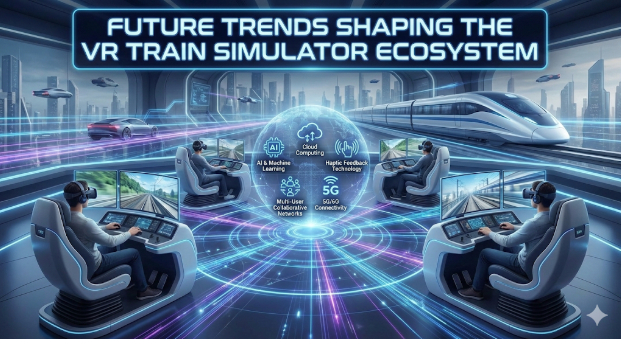
The railway is receiving a silent but strong transformation. Due to the development of rail networks and the increase in safety standards, as well as the technological level, training and simulation approaches should also change accordingly. The VR train simulator is at the heart of this change as it is rapidly turning smarter, more engaging, and more data-driven. What used to be the simplest tool of training is becoming an all-encompassing digital ecosystem.
The next generation of VR train simulators will not only transform the learning, practicing, and performance optimization processes of rail professionals but was developed in partnership with a 3D visualization firm.
More Realism With Hyper-Accurate Digital Twins
The use of digital twin technology is one of the most influential trends that is changing the ecosystem of the VR train simulator. Simulators in the future will be able to reproduce the real-life trains, tracks, stations, and environments with near perfection.
Such digital twins will make possible:
- Gradients and curves are trained on routes.
- On-the-fly simulation of rolling stock behaviour.
- Cab interiors and control panels are very realistic.
A special 3D visualization firm is important in the construction of these hyper-detailed environments in a manner that makes them look and work like the real world.
AI- Driven Adaptive Training Scenarios
Artificial intelligence is reshaping the response of VR simulators to the users. The VR train simulator platforms of the future will not have fixed scenarios but will alter dynamically depending on the behavior of the trainees.
Artificial intelligence applications will encompass:
- Individualized difficulty scale.
- Smart error reporting and foreign policy.
- Adjustments of scenarios according to trends of performance.
This dynamic method makes each training session relevant, challenging, and effective.
Growth of Multi-User and Collaborative Training
The next generation of training in railways will be out of the confines of individual learning. The VR train simulator ecosystem is evolving towards collaborative, multi-user systems in which various roles may train at the same time.
This includes:
- The training of drivers and signal operators.
- The teams in the control rooms that oversee virtual traffic.
- Interdepartmental coordination in case of emergency.
These common environments assist in enhancing communication and collaboration in the operations of the railways, with the assistance of a strong 3D visualization firm.
Integration With Real-Time Operational Data
One more significant tendency is to combine live and historical data in VR settings. A VR train simulator will be more realistic and accurate to the real-life operating conditions based on the data of the real rail networks.
This integration enables:
- Training using actual incidents.
- Comparison of the real operations with benchmarking.
- Predictive learning based on previous system failures.
Simulations like these, based on data, make the training more similar to actual operating challenges.
Remote Accessibility and Cloud-Based Simulation
The way VR solutions are being offered is being transformed through cloud computing. Rather than having to have large on-site infrastructure, future platforms of VR train simulations will be cloud-based and can be accessed from a distance.
Key benefits include:
- Scalable deployment across locations
- Quick response time and delivery of content.
- Less dependency on hardware.
An innovative 3D visualization firm guarantees seamless optimization of devices without loss in visual quality.
Increased Attention to Safety and Compliance Training
With the global increase in safety regulations, the number of compliance-based training sessions being conducted in VR simulators will rise. The VR train simulator environment will integrate regulatory requirements into the simulation processes.
This trend supports:
- Compliance tests that are automated.
- Unified safety qualifications.
- Risk awareness training that is scenario-based.
These features enable organizations to remain audit-ready, coupled with an enhanced safety culture.
Enhanced Analytics and Performance Insights
Analytics will be more central in the future VR platforms. Not only will a VR train simulator be able to train users, but also produce actionable insights.
Improved analytics will monitor:
- Response times and patterns of decision-making.
- Procedural compliance
- Skill progression over time
These can be used to assist trainers in creating programs more customized to suit the workforce better and enhance workforce readiness.
Cross-Industry Learning and Simulation Reuse
With the advancement of simulation technologies, the VR train simulator ecosystem will learn from the experiences of aviation, defense, and automotive training.
This convergence leads to:
- Stronger simulation engines.
- Improved realism standards
- Faster innovation cycles
There is a multidisciplinary 3D visualization company that assists in transferring these learnings to railway-specific applications.
Greater Adoption in Education and Workforce Development
The use of VR-based tools will become more active in educational institutions and training academies. The VR train simulator will also be a fundamental part of railway training, not necessarily professional training.
This trend equips the students with:
- Hands-on experience before hiring.
- Greater familiarity with the actual working environment.
- Shorter time to onboard employees.
Conclusion
The progress of the VR train simulator ecosystem is smart, interconnected, and immersive. As AI develops, data integration, cloud computing, and shared training, these simulators are becoming the crucial tools in the safety, productivity, and training of railways.
Supporting the experience of a 3D visualization firm, VR train simulators will go on to define the future of rail training, changing the way professionals learn today and how they will prepare for the rail networks of tomorrow.